
Simone Weil
A philosopher for whom attention, given fully to a problem, a person or the world, was a form of love and of prayer.
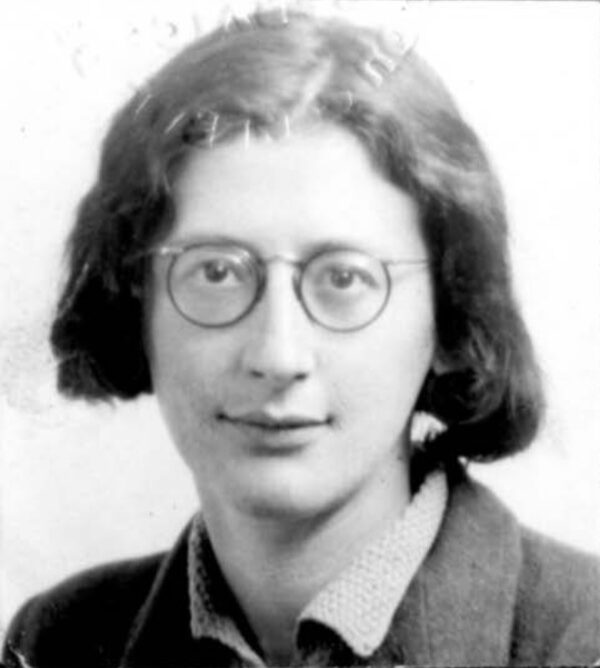
Who she was
Simone Weil was born in Paris in 1909. She studied philosophy at the École normale supérieure and taught in girls’ schools across France, while giving her wages and her free time to workers’ causes. In 1934 she took leave to work on factory assembly lines, to learn from the inside what such work does to a person, and in 1936 she joined the anarchist militia in the Spanish Civil War.
From 1937 a series of mystical experiences turned her toward Christianity, though she chose not to be baptised. She fled occupied Paris with her family in 1940, worked on farms in the south of France, and reached New York in 1942 and London later that year, to work for the Free French. Ill with tuberculosis, and eating little, it is said, out of solidarity with those living on rations in occupied France, she died in Ashford, Kent, on 24 August 1943, aged 34.
Almost none of her books appeared in her lifetime. Friends and editors gathered them from her notebooks, letters and essays after the war. Each line in Embering links to a page below, where you can read it in the passage it comes from.
Her books
- Attente de Dieu (1950)Waiting for God · La ColombeRead free →
- La Pesanteur et la grâce (1947)Gravity and Grace · PlonRead free →
- L’Enracinement (1949)The Need for Roots · GallimardRead free →
- Écrits de Londres et dernières lettres (1957)Writings from London and last letters · GallimardRead free →
- Pensées sans ordre concernant l’amour de Dieu (1962)Unordered thoughts on the love of God · GallimardRead free →
Attente de Dieu (1950)
- People capable of attentionReflections on the right use of school studies
- Twenty minutes of attentionReflections on the right use of school studies
- The joy of learningReflections on the right use of school studies
- Not sought, but waited forReflections on the right use of school studies
- Enough that you existLetter III
- Go on lovingThe love of God and affliction
- Joy and painThe love of God and affliction
- The folds of the mountainsThe love of God and affliction
- A tender smileForms of the implicit love of God
La Pesanteur et la grâce (1947)
- Attention is prayerPages 133–134
- Consent to distancePage 78
- Love yourself as a strangerPage 74
- Love is lightPages 21–22
- Guard your solitudePages 79–80
- To be read differentlyPage 152
- The true GodPages 85–86
- Grace fillsPage 18
- Bear the emptinessPage 18
- Attention, not willpowerPage 133
- Nothing closer to humilityPage 147
- Without wanting to eat itPage 170
- The instant and the eternalPages 168–169
- Acceptance, lovePage 76
- The truth of the worldPage 20
L’Enracinement (1949)
Écrits de Londres et dernières lettres (1957)
Pensées sans ordre concernant l’amour de Dieu (1962)
Every passage here is a new translation from Weil’s French, made for Embering. The French texts are available in full, free, from Les Classiques des sciences sociales at the Université du Québec.
Close this page to return to your line in Embering.
Simone Weil’s lines arrive one a day in Embering, a quiet app for reading a single line slowly.
Get Embering